
Structural Advantages of Stainless Steel Kitchen Carcass
Why Stainless Steel Carcass Is the Backbone of a Durable Modular Kitchen
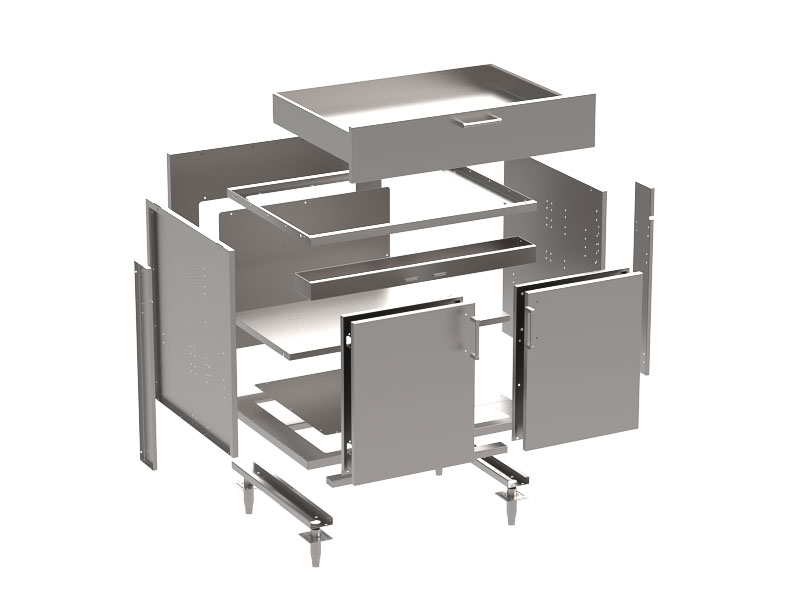
In recent years, architects and premium homeowners have shifted toward stainless steel kitchen carcass systems instead of traditional plywood or MDF structures. The reason is clear: structural performance, longevity, and resistance to environmental damage.
In this detailed guide, we explain the structural advantages of stainless steel kitchen carcass, why it outperforms wooden alternatives, and why it is becoming the preferred foundation for modern modular kitchens in India.
Structural Advantages of Stainless Steel Kitchen Carcass
What Is a Kitchen Carcass?
A kitchen carcass is the internal body of the cabinet — including:
-
Side panels
-
Bottom and top panels
-
Back panel
-
Internal shelves
-
Drawer support frames
Shutters and finishes are external elements. The carcass carries the load and determines long-term durability.
If the carcass fails, the entire kitchen system weakens.
Why Stainless Steel Carcass Is Structurally Superior
Exceptional Load-Bearing Strength
Structural Benefits:
-
Handles heavy granite or quartz countertops
-
Supports fully loaded pull-out systems
-
Prevents sagging shelves
-
Maintains alignment over decades
Wood-based cabinets can bend under long-term load, especially near sinks and hob units. Stainless steel maintains rigidity even under high stress.
100% Termite and Pest Resistance
Wooden carcasses are vulnerable to:
-
Termites
-
Borers
-
Rodents
-
Cockroach infestation
Even treated plywood is not permanently protected.
Stainless steel carcass systems eliminate this risk completely. Since steel is non-organic, pests cannot damage it. This ensures structural stability in all climate zones, including humid regions like Chennai, Bangalore, and coastal areas.
Zero Water Absorption
Water exposure is the biggest enemy of wooden kitchens.
Common failure points in plywood carcasses:
-
Sink base cabinet swelling
-
Delamination
-
Joint separation
-
Mold growth
Stainless steel does not absorb moisture. It does not swell, warp, or rot. Even in continuous exposure to water (under-sink areas), the structure remains intact.
This makes stainless steel carcass ideal for:
-
Sink units
-
Dishwasher units
-
Utility kitchens
-
Coastal properties
Welded Structural Integrity
Many premium stainless steel kitchens use fully welded carcass construction instead of screw-fixed assembly.
Structural advantages of welded systems:
-
No loose joints over time
-
High torsional strength
-
No structural movement
-
Long-term dimensional stability
In contrast, wooden cabinets rely on screws and adhesives. Over time, vibration, moisture, and load stress weaken these joints.
A welded stainless steel carcass acts as a single integrated structure.
Modular Stainless Steel Carcass (Knock-Down System)
-
Assembled on site using screws, connectors, and fasteners
-
Individual panels are cut and fixed together
-
Easier to transport and dismantle
-
Faster installation
-
Slight movement possible over time due to mechanical joints
Best suited for: Apartments, projects requiring flexible installation, or locations with access limitations.
Fire Resistance and Heat Stability
Kitchen environments involve constant heat exposure from:
-
Gas stoves
-
Ovens
-
Chimneys
-
Hot utensils
Wood-based carcasses are combustible and degrade over time due to heat.
Stainless steel is:
-
Non-combustible
-
Heat-resistant
-
Structurally stable under temperature fluctuations
For premium residential projects and high-rise apartments, fire-resistant materials are increasingly preferred by architects.
Long-Term Dimensional Stability
Wood reacts to climate changes. It expands and contracts due to humidity variations.
This leads to:
-
Shutter misalignment
-
Drawer fitting issues
-
Structural twisting
Stainless steel maintains dimensional stability regardless of:
-
Humidity
-
Temperature
-
Seasonal change
This ensures smooth drawer operation and perfect alignment even after years of usage.
Corrosion Resistance (SS 304 Grade)
High-quality kitchens use SS 304 food-grade stainless steel, known for its corrosion resistance.
Key structural benefits:
-
Rust-resistant surface
-
Long lifespan
-
Suitable for humid Indian climates
-
Resistant to chemical cleaning agents
Lower-grade steel may corrode over time, but properly processed SS 304 carcasses provide decades of reliable performance.
Hygienic and Anti-Bacterial Surface
Unlike plywood, stainless steel does not support:
-
Fungal growth
-
Mold formation
-
Bacterial penetration
This is particularly important for families prioritizing hygiene.
Hospitals, commercial kitchens, and food-processing industries rely on stainless steel for this reason. The same structural advantage applies to residential kitchens.
High Impact Resistance
Daily kitchen usage involves:
-
Slamming drawers
-
Heavy cookware storage
-
Frequent opening and closing
Wooden carcasses can crack at screw points. Over time, screw holes loosen.
Stainless steel carcass systems:
-
Resist impact stress
-
Maintain screw integrity
-
Prevent structural cracking
This significantly extends kitchen life.
Sustainability and Environmental Strength
From a structural lifecycle perspective, stainless steel offers:
-
100% recyclability
-
No deforestation
-
Lower long-term replacement cost
While initial cost may be higher than plywood, the life-cycle cost of stainless steel carcass is lower due to:
-
No replacement
-
No termite treatment
-
No structural repair
This makes it a sustainable investment for premium homeowners.
Stainless Steel Carcass vs Wooden Carcass – Structural Comparison
| Feature | Stainless Steel Carcass | Wooden Carcass |
|---|---|---|
| Termite Resistance | 100% | No |
| Water Resistance | 100% | Limited |
| Load Strength | High | Moderate |
| Fire Resistance | Yes | No |
| Lifespan | 25+ Years | 8–12 Years |
| Structural Stability | Permanent | Degrades over time |
For long-term projects, stainless steel clearly delivers structural superiority.
Why Architects Prefer Stainless Steel Kitchen Carcass
Architects prioritize:
-
Structural longevity
-
Safety compliance
-
Client satisfaction
-
Minimal maintenance complaints
Stainless steel carcass systems reduce post-installation issues and warranty claims. This makes them highly attractive for:
-
Luxury apartments
-
Villas
-
Coastal properties
-
High-humidity regions
The structural integrity aligns with modern construction standards.
Applications in Modern Residential Kitchens
Stainless steel carcass systems are ideal for:
-
Luxury modular kitchens
-
Open kitchen concepts
-
Island kitchens
-
Utility areas
-
Wet kitchens
They also support multiple finish options:
-
Powder-coated finish
-
PU paint finish
-
Glass shutters
-
Acrylic panels
The carcass remains structurally superior regardless of exterior finish.
Investment Perspective
A kitchen is a 15–25 year investment.
Choosing plywood carcass may reduce upfront cost but increases long-term risk:
-
Structural failure
-
Water damage
-
Termite repair
-
Complete replacement
Stainless steel carcass offers:
-
Structural permanence
-
Reduced maintenance
-
Higher resale value
-
Premium positioning
From an ROI perspective, it is a smarter long-term decision.
Conclusion: The Structural Backbone of a Modern Kitchen
The structural advantages of stainless steel kitchen carcass are clear:
-
High load-bearing capacity
-
100% termite proof
-
Water and heat resistant
-
Welded structural strength
-
Long-term dimensional stability
-
Corrosion resistance
-
Hygienic and sustainable
While shutters define aesthetics, the carcass defines durability.
For homeowners building a long-lasting modular kitchen, stainless steel carcass provides structural reliability that wood cannot match.
Karvi Interio specializes in precision-engineered stainless steel modular kitchen systems using high-grade SS 304 carcass structures designed for Indian homes and climate conditions. If you are planning a premium, long-term kitchen investment, start with the right structural foundation.
Ready to explore a Basic Range of Wood, an Affordable range of galvanized steel and Premium stainless steel kitchen cabinets in Bangalore, kitchen interior & wardrobe solutions for your space? with different combination shutters complete home interiors in steel with Stainless Steel PVD Furniture Contact Karvi Interio today for personalized consultations and expert design services. Visit our website to discover the efficiency and durability of stainless steel wardrobes tailored to your needs. Construction for interior products Gauge, visit our YouTube channel for information videos, Before visiting the showroom some of the steps to follow, Looking for Collaboration with US, About warranty & guarantee, Transform your storage spaces with Karvi Interio’s expertise!
FAQ
1. What is a stainless steel kitchen carcass?
A stainless steel kitchen carcass is the internal structural framework of modular cabinets made from SS 304 grade steel, providing strength, water resistance, and long-term durability.
2. Is stainless steel carcass better than plywood?
Yes. Stainless steel carcass is termite-proof, water-resistant, fire-resistant, and structurally stronger than plywood, making it more durable in Indian climates.
3. Which grade stainless steel is used for kitchen carcass?
SS 304 food-grade stainless steel is commonly used due to its corrosion resistance, strength, and hygienic properties.
4. Does stainless steel kitchen carcass rust?
High-quality SS 304 stainless steel does not rust under normal residential conditions when properly fabricated and installed.
5. Is stainless steel carcass suitable for residential kitchens?
Yes. It is ideal for luxury homes, villas, apartments, and coastal properties where moisture resistance and long-term durability are essential.
6. How long does a stainless steel kitchen carcass last?
A properly engineered stainless steel carcass can last 20–25+ years with minimal maintenance.
6. Difference between Modular stainless steel & Welded stainless steel carcass?
Both systems use SS 304 stainless steel and are termite-proof and water-resistant. However, welded stainless steel carcass offers superior structural strength and long-term durability, making it ideal for premium kitchens.
Modular stainless steel carcass is practical and efficient, while welded carcass is engineered for maximum structural performance.